My deep dive into the world of watchmaking has its perks. One of them is meeting exceptionally talented and creative individuals, full of vision and imagination, who truly stand out in everything they do. One such person is Kurt Klaus, whom I had the pleasure of meeting several times at the Salon International de la Haute Horlogerie in Geneva – now known as Watches and Wonders. The beloved Mr. Klaus was a regular at IWC’s impressive booth, often playing the role of host. A charismatic conversationalist, with a commanding presence despite his short stature, he was always kind and approachable. Even after retiring – following more than four decades with IWC – he never stopped traveling the world, teaching young watchmakers, and speaking about his inventions and his passion for horology.
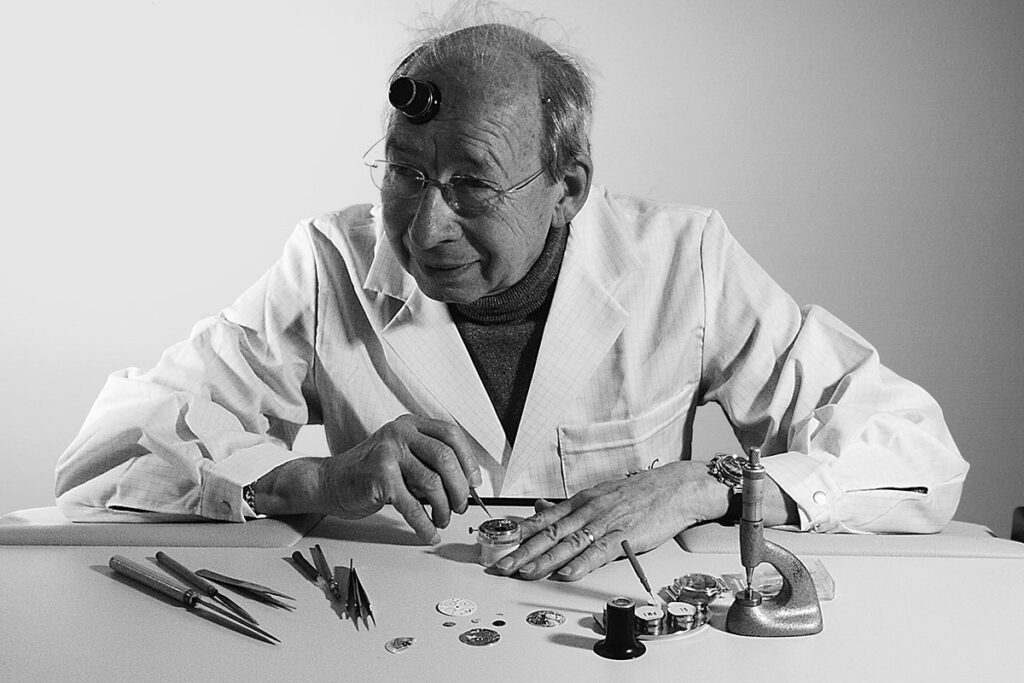
Born in 1934 in St. Gallen, Switzerland – now a proud 90 years old – Kurt Klaus began his career as a watchmaker in IWC Schaffhausen’s service department in 1957. From 1970 to 1999, he focused on developing, constructing, and designing original mechanical movements. It was during this time that he conceived his now-legendary perpetual calendar.
Kurt Klaus, Schaffhausen 2014
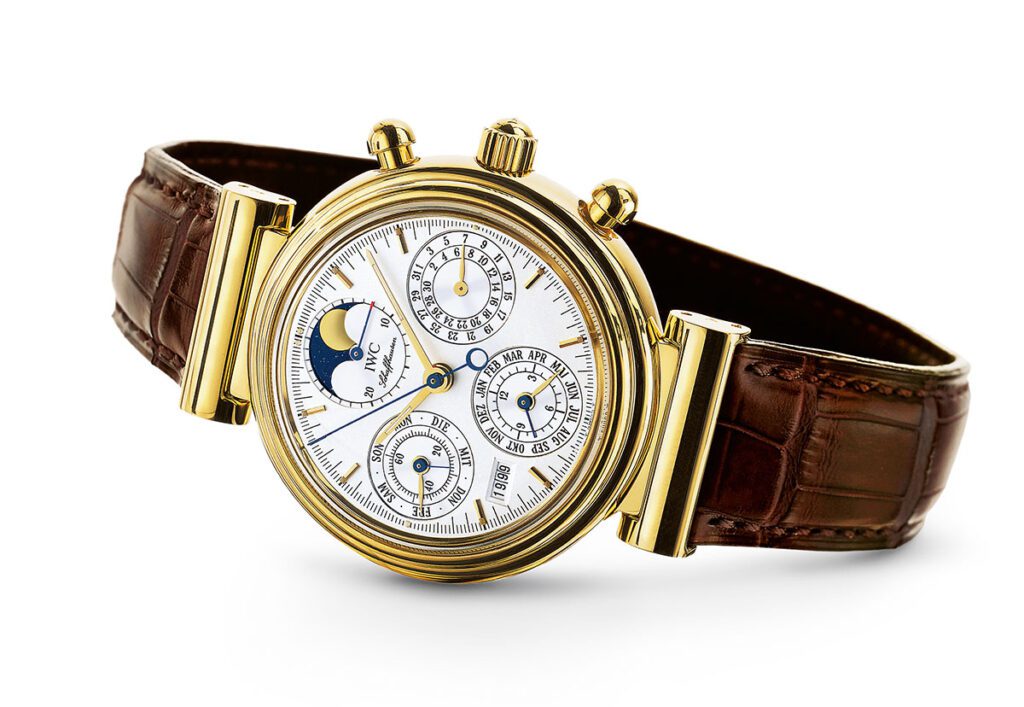
IWC Da Vinci Perpetual Calendar Chronograph, reference 3750 (1985)
Time Without End
In the 1970s, when mechanical Swiss watchmaking was struggling in the face of quartz technology and its future seemed uncertain, Kurt Klaus was assigned to develop complex complications for pocket watches. Having already created his first annual calendar, he decided to bring to life a dream of his: a perpetual calendar for a wristwatch. His creation made its debut at the Basel fair in 1985: the Da Vinci Perpetual Calendar Chronograph, reference 3750. The calendar mechanism consisted of just 81 cleverly arranged components, and all indications could be advanced using a single crown – a first in the history of watchmaking. This mechanical marvel not only recognized the number of days in each month but also automatically added a leap year every four years. This meant that the wearer wouldn’t have to adjust the date until the year 2100! Never before had a perpetual calendar been so devilishly simple in design, so user-friendly and easy to assemble, and so high in quality.
Over the years, Kurt Klaus continued to develop and improve his calendar. For example, he oversaw the integration of the calendar mechanism into IWC’s 50000-caliber family, which led to the launch of the first Portugieser Perpetual Calendar (ref. IW5021) in 2003 – a watch that offered moonphase accuracy for an astounding 577.5 years! Klaus also played a key role in the creation of IWC’s first perpetual calendar with digital displays for the date and month: the Da Vinci Perpetual Calendar Digital Date-Month (ref. IW3761), released in 2009.
IWC Il Destriero Scafusia Grande Complication (1993) & IWC Da Vinci Perpetual Calendar Digital Date-Month (2009).
IWC Portugieser Perpetual Calendar “Horizon Blue” (2024)
And Much More…
Although his name is synonymous with the perpetual calendar, many other IWC innovations wouldn’t exist without Kurt Klaus. Among other contributions, he helped develop several manufacture movements, the split-seconds chronograph (rattrapante) system, a world time mechanism, and a mechanical depth gauge for dive watches. He was also instrumental in the creation of the famous Il Destriero Scafusia in 1993 – at the time, the most complicated wristwatch in the world.
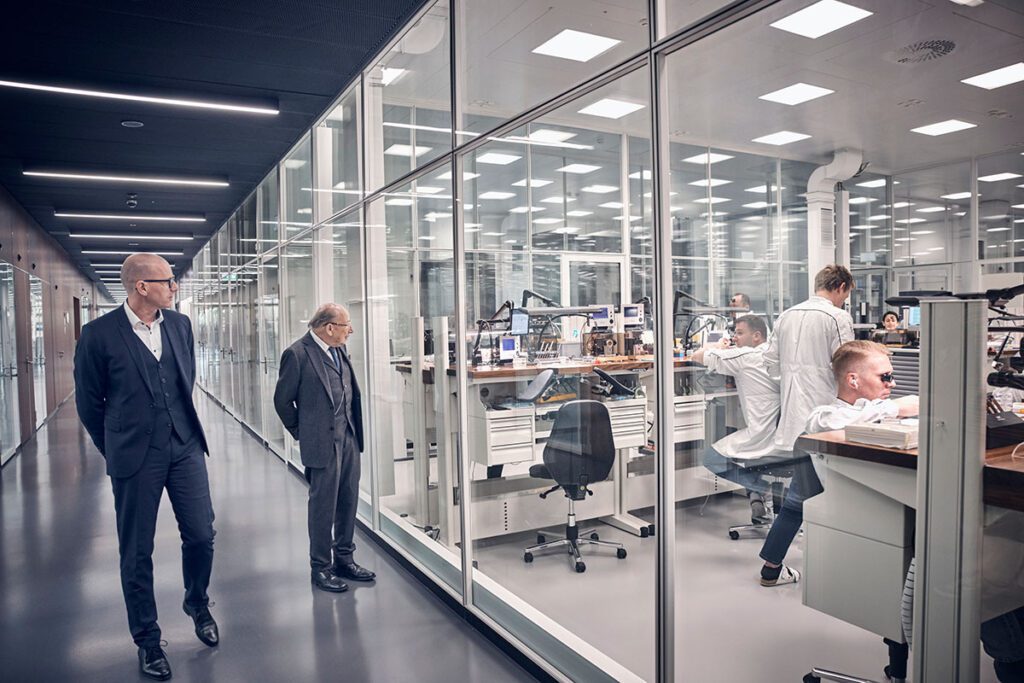
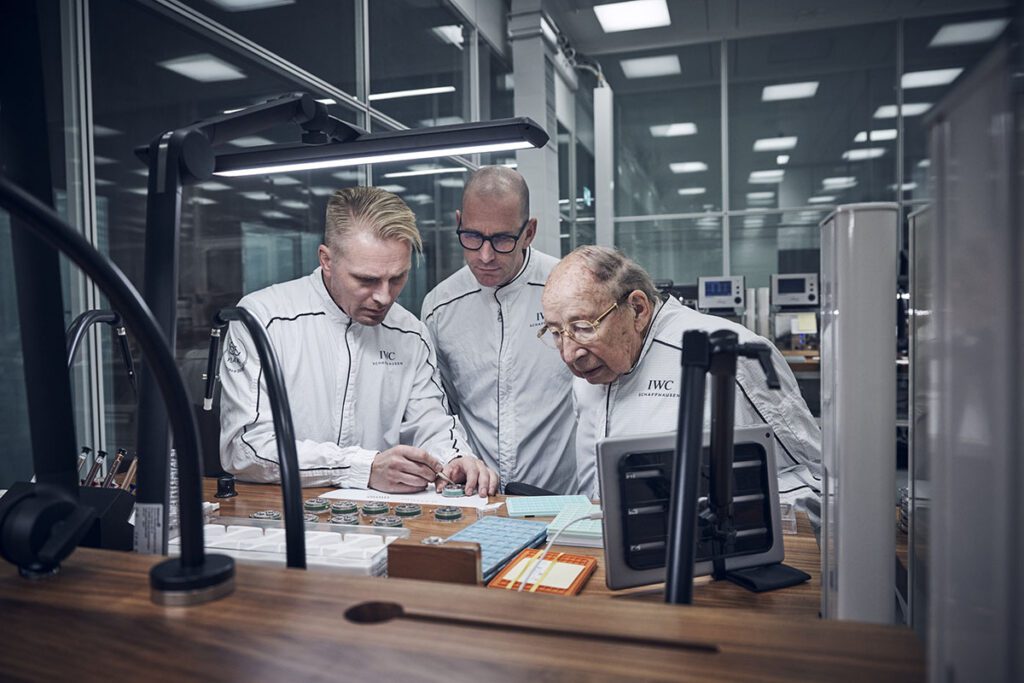
Kurt Klaus and Markus Buhler, Associate Director of Watch and Movement Assembly at IWC Schaffhausen
Humble and humorous, Klaus is one of the most cult-like figures in the industry and greatly beloved by watch aficionados. In 2022, he even made his social media debut in a humorous IWC campaign titled “A smart watch – And a half.” A series of short clips showed the legendary watchmaker entering a smartwatch store, cleverly highlighting the shortcomings of electronic devices compared to mechanical timepieces built to last for generations.