2025: A Turning Point for Watchmaking?

Deloitte Swiss Watches Study 2025
Recovery or slowdown? The annual Deloitte Swiss Watch Industry Study sheds light on the state of the industry, revealing key insights about trends, tariffs, consumer preferences, the pre-owned market, and the use of artificial intelligence.

How is the watchmaking industry performing in 2025? The Deloitte Swiss Watch Industry Study 2025, which has just been published, offers some compelling answers. For those unfamiliar with it, Deloitte is one of the world’s largest networks of professional services firms, operating in more than 150 countries and employing over 460,000 professionals. For the past eleven years, it has conducted an annual study dedicated to the Swiss watch industry. This year’s research was based on an online survey completed by 111 senior executives between June and July 2025, along with interviews with industry experts. At the same time, Deloitte carried out a separate online survey of 6,500 consumers in both the Swiss domestic market and major export markets for Swiss watches: China, France, Germany, Hong Kong, India, Italy, Japan, Singapore, the United Arab Emirates, the United Kingdom, and the United States. For the first time, the 2025 edition also includes Mexico, with a special section devoted to this rapidly growing market.

The Deloitte report is quite extensive, but here we focus on its main findings and on how the watchmaking industry has performed so far in 2025.

Deloitte Swiss Watches Study 2025
©Watches & Wonders
  • Positive or negative outlook?

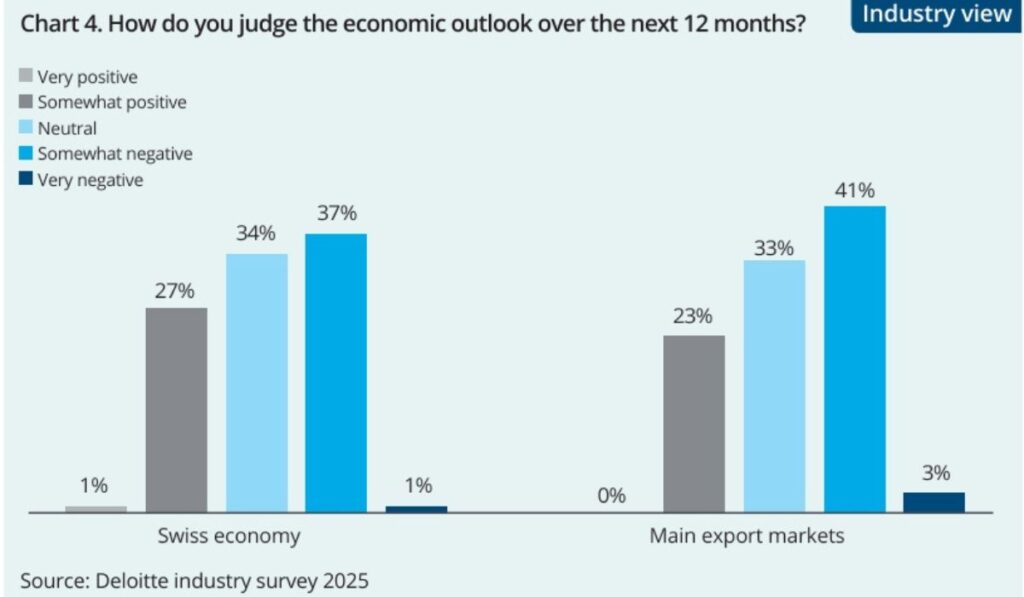
According to the study, 43% of industry executives remain pessimistic about growth prospects in the main export markets, compared to just 23% who see the future in a more positive light. Subcontractors – often the first to sense turbulence – report investment cutbacks and an increase in short-term contracts. Even so, 61% of respondents plan to prioritize the launch of new products within the next year, a positive sign that innovation and R&D remain high on the industry’s agenda.

  • Enter the robots

The use of artificial intelligence continues to evolve. Although it is still mainly employed for content creation and efficiency gains, brands are now experimenting more boldly. Nearly one in three executives (29%) plan to use AI for creative product development, up from 20% in 2023.

  • The store stays strong

Two-thirds of brands and retailers report that online sales account for around 10% of their total revenue, while 16% continue to sell exclusively through physical stores. Most executives believe that brick-and-mortar locations will remain the dominant sales channel over the next five years.

Deloitte Swiss Watches Study 2025
The brand-new exclusive Vacheron Constantin boutique in Paris is a modern temple of luxury.
  • A retail divide

While 41% of executives plan to open new mono-brand or flagship boutiques within the next 12 months, consumers seem to prefer the opposite: 38% say they favor multi-brand stores, compared to only 23% who prefer mono-brand boutiques.

  • Second-hand rising

The pre-owned watch market continues to grow, particularly among younger buyers. 40% of Millennials and Gen Z respondents say they are likely to purchase a pre-owned timepiece within the next year, a significantly higher share than among Gen X or Baby Boomers.

  • Looking ahead

Purchase intent is now equally strong among men and women, suggesting that demand is no longer driven primarily by male collectors. The greatest growth potential lies with female buyers and Generation Z, who are expected to shape the future of the watch industry.

Deloitte Swiss Watches Study 2025
Most watchmakers are investing increasingly in women’s timepieces to meet the needs of this growing audience. Breitling, for instance, has expanded its Premier collection with elegant models designed specifically for ladies.
How has the year unfolded so far?

After the disruptions of the pandemic, 2023 marked a record year for Swiss watchmaking, with exports reaching an all-time high of CHF 26.7 billion. But by early 2024, signs of slowing demand began to emerge. Secondary market prices softened, inventories grew, and the industry recorded a decline in exports. Overall, export revenues in 2024 dropped by nearly 3% compared to 2023, while export volumes fell by 10%, roughly 1.5 million fewer watches were sold than the previous year. The decline was concentrated in watches priced below CHF 3,000 at export level (equivalent to roughly CHF 6,000–8,000 retail), where export earnings fell by 16%. Higher-end segments proved more resilient, with export value up by 1% despite a 4% decline in volume.

Deloitte Swiss Watches Study 2025
©Watches & Wonders

In the first half of 2025, there were some encouraging signs, though the overall market remained fragile. January and February continued the downward trend before a short but sharp rebound in March and April lifted sentiment. Optimism spread during Watches & Wonders Geneva in April—the year’s major watchmaking event—as brands unveiled a wide array of new creations, including one of the most talked-about launches of the year, the Rolex Land-Dweller.

Deloitte Swiss Watches Study 2025
One of the most notable launches at this year’s Watches & Wonders in Geneva was the Rolex Land-Dweller.

But the positive mood didn’t last long. Declines resumed in May and June, while July delivered mixed results: export revenues rose about 7% year-on-year, but this was largely driven by a surge of shipments to the United States ahead of new 39% tariffs on Swiss goods, first introduced in April and raised significantly in August. Without these exceptional shipments, exports would have fallen by nearly 1%. In August, exports declined again, resulting in an overall drop of about 1% for the first eight months of 2025.

Deloitte Swiss Watches Study 2025
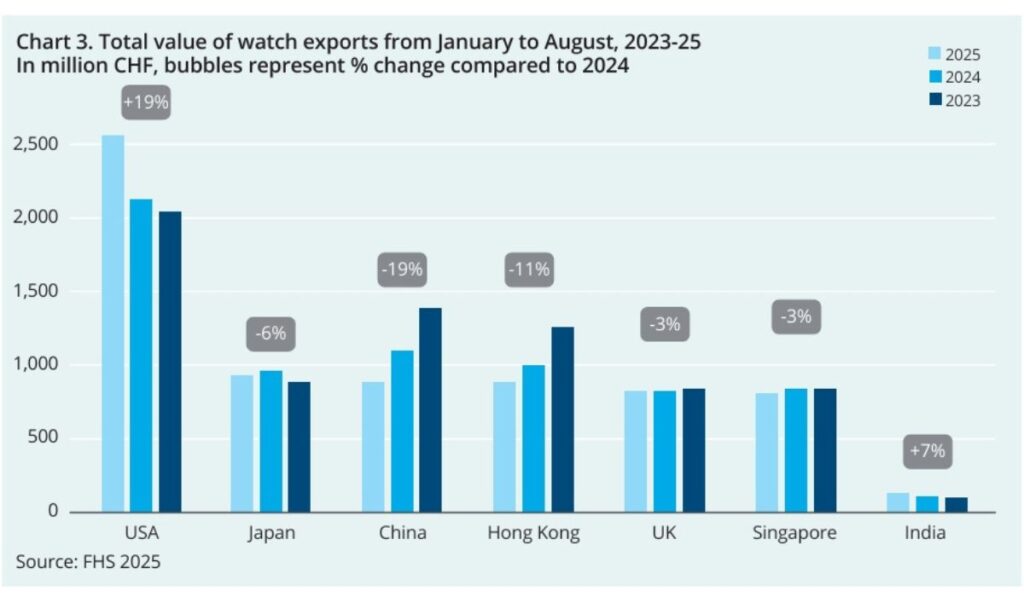
Table showing the total value of Swiss watch exports from January to August for the years 2023 to 2025. The percentages in grey indicate the year-on-year changes compared to 2024.
The Tariff Shock

In 2025, the international landscape for Swiss watches has become markedly more complicated. In April, the U.S. government imposed a universal 31% import tariff on goods from Switzerland, with a grace period during which only a 10% tariff applied, allowing both sides time to negotiate a resolution. No agreement was reached, and on August 7 new tariffs came into effect — higher than expected, at 39% instead of 31%.

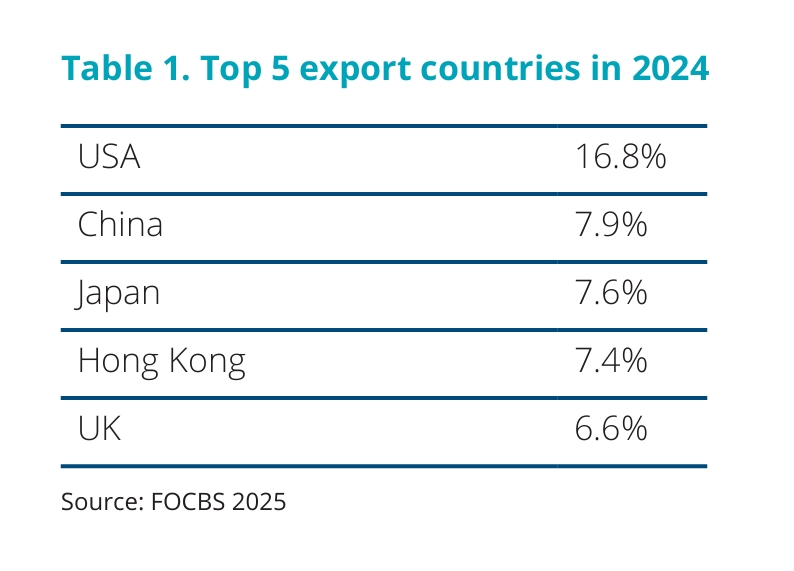
The implications are serious. Since 2021, the U.S. has been the most important export market for Swiss watches, overtaking China that year. In 2024, exports to the U.S. reached CHF 4.4 billion, accounting for 16.8% of total Swiss watch exports. The tariffs themselves, along with uncertainty about future developments, are complicating planning and investment decisions, increasing the pressure on the industry. The impact extends beyond watchmaking: timepieces account for 9.2% of all Swiss exports, making them the country’s second-largest export category after pharmaceuticals.

Deloitte Swiss Watches Study 2025
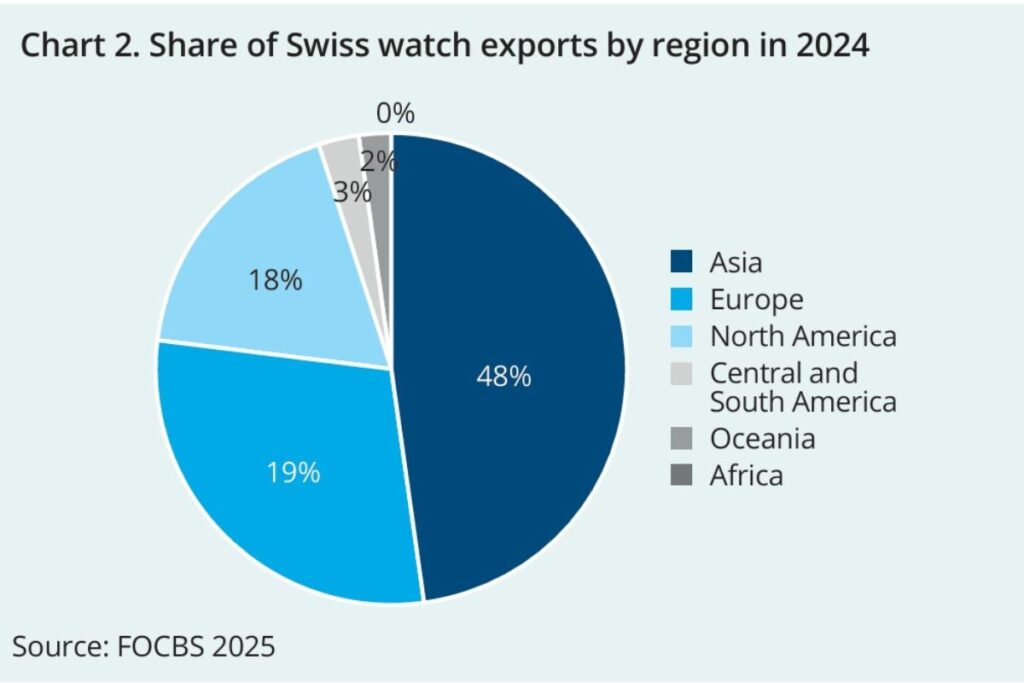
Table showing the share of Swiss watch exports by region in 2024.

The surprise U.S. tariff announcement sent the industry into a frenzy. Brands and retailers rushed to build up inventory in the U.S. before the higher tariffs took effect. As a result, exports to the U.S. in April 2025 surged by +150% compared to the same month in 2023, with another +45% spike recorded in July. These surges led to an overall +19% year-on-year increase in exports to the U.S. over the first eight months of the year. However, this trend is expected to reverse, not only because many shipments were brought forward to avoid the tariffs, but also due to changing market dynamics.

Several watchmakers, including Rolex, Patek Philippe and certain Swatch Group brands, have responded by announcing retail price increases in the U.S., which are likely to impact demand. Others, reportedly, have held off raising prices, attempting instead to absorb or gradually pass on costs, though this is unlikely to be sustainable if tariffs remain in place.

Deloitte Swiss Watches Study 2025
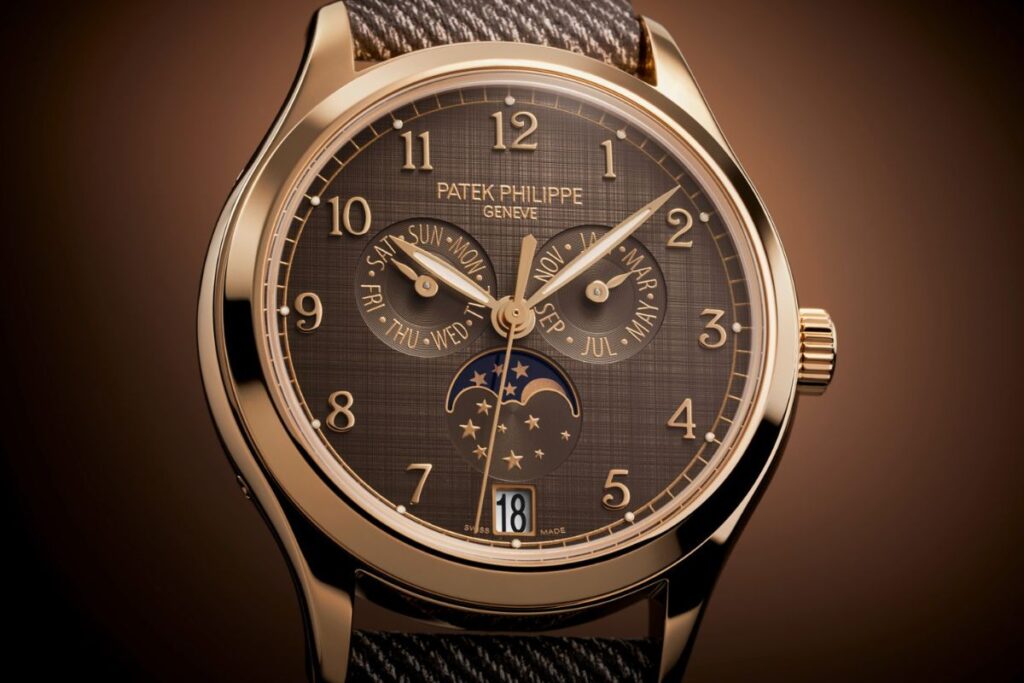
Patek Philippe 4946R Annual Calendar: one of the brand’s brand-new creations for 2025.

The secondary market has also been affected, as U.S. tariffs apply to all imported Swiss watches, new or pre-owned, regardless of their origin. For now, American resellers who managed to stock up in advance hold a temporary advantage, but that edge will not last long. Uncertainty surrounding future availability and price fluctuations is causing many retailers to pause transactions as they wait for the situation to stabilize. In any case, American consumers are expected to face higher prices soon. Even after the initial 10% tariff announcement in April, pre-owned watch prices saw moderate increases. It remains to be seen to what extent retailers will be able to pass on the added costs of the August tariff hike.

Much will depend on how price-sensitive U.S. consumersprove to be. For now, signs point to caution. According to Deloitte’s June 2025 U.S. Economic Outlook, consumer spending is slowing. Real personal consumption expenditures rose by just 1.2% in Q1, far below the 4% growth recorded in Q4 2024. Spending on durable goods fell by 3.8% in the first quarter and is forecast to contract by 0.7% in 2025 and 0.2% in 2026. The Deloitte Financial Well-Being Index also indicates a cooling economy, dropping from 105.5 in December 2024 to 98.6 in June 2025, a sign that consumers are feeling the financial strain and are becoming more cautious with their spending.

Deloitte Swiss Watches Study 2025
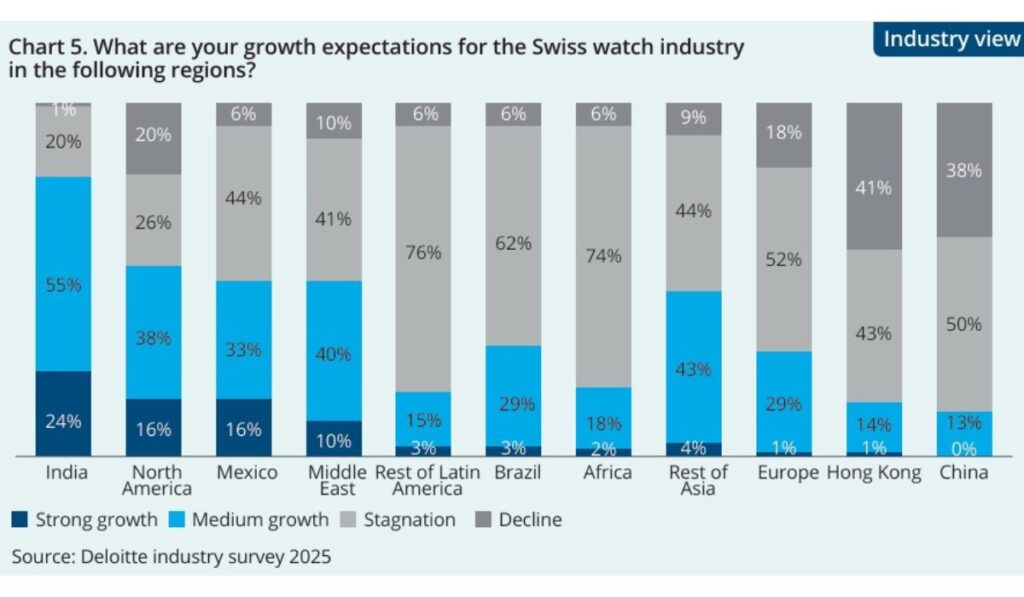
Growth forecasts for the Swiss watch industry across specific markets.
A Global Snapshot

In Asia, the picture remains subdued. The Chinese and Hong Kong markets continue to face pressure. In 2024, Swiss watch exports to China fell to CHF 2.1 billion, a 26% year-on-year decline and 31% below 2021 pandemic levels. Exports to Hong Kong also fell by 19% compared to 2023, reaching CHF 1.9 billion. Combined, these two markets represented 15% of Swiss watch exports in 2024.

Elsewhere in the Asia-Pacific region, performance has been mixed. Exports to Singapore and Japan posted annual declines of 3% and 6%, respectively, in the first eight months of 2025. Consumer sentiment was fragile and exchange rates unfavourable. By contrast, India stands out as a bright spot. Exports to the country rose nearly 7% between January and August compared to the same period in 2024, and more than 30% compared to 2023. With strong domestic demand, rising affluence, and growing investment in retail infrastructure, India remains the fastest-growing major market for Swiss watches.

The bottom line? Global trends are diverging. The traditional powerhouses, the U.S. and China, are struggling, while new, emerging markets such as India offer opportunities, but not yet on a scale sufficient to offset the decline in the industry’s largest traditional markets.

Deloitte Swiss Watches Study 2025
Assessment of the economic outlook for the next 12 months.
Luxury endures

Overall, the mood across the watchmaking industry remains uncertain. In Deloitte’s July 2025 survey of Swiss watch executives, conducted before the 39% U.S. tariff increase, respondents viewed Switzerland’s economic outlook as negative, with 43% also judging prospects in their main export markets unfavorably.

Opinions, however, vary across price categories. High-end watches (priced above CHF 50,000) are expected to perform best, with 64% of executives expressing confidence in this segment. For luxury watches priced between CHF 10,000 and 50,000, sentiment is more cautious: 38% remain neutral and 32% optimistic. In contrast, the outlook for entry-level (under CHF 1,500) and mid-range (CHF 1,500–10,000) segments is decidedly negative, with nearly 60% of executives rating their prospects as poor. This divergence reflects the ongoing “premiumisation” trend shaping the market in recent years. Higher-end models continue to show resilience, seemingly unaffected by inflation or macroeconomic headwinds.

Deloitte Swiss Watches Study 2025
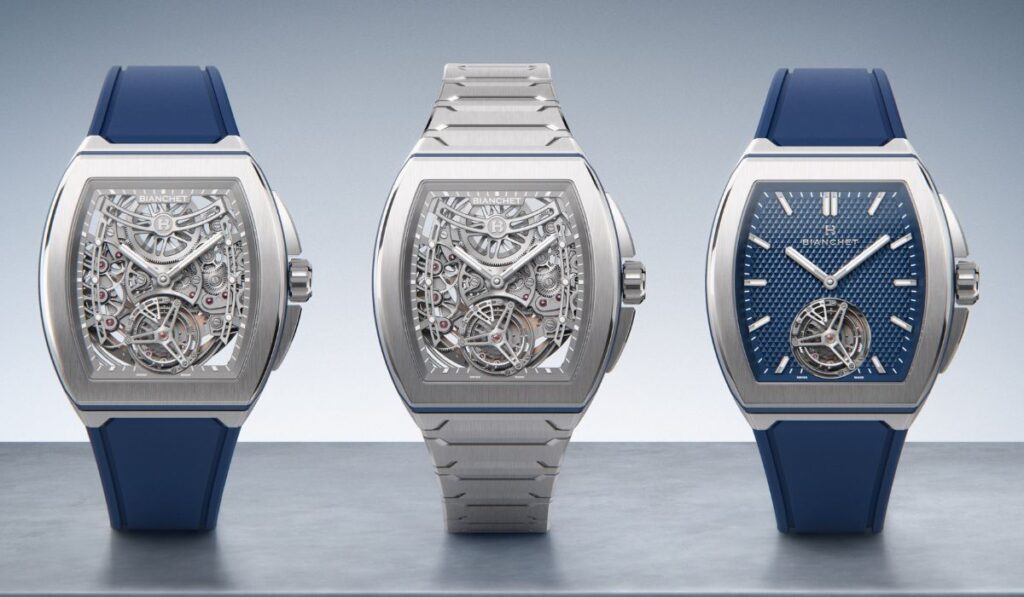
High watchmaking models with retail prices above 50,000 Swiss francs are not expected to face major challenges. One example is Bianchet, a brand specializing in tourbillons. Pictured: the new Bianchet B 1.618 UltraFino models.

When asked about expected growth across regions, executives were particularly pessimistic about China and Hong Kong, with 38% and 41% anticipating declines — the most negative scores across all markets surveyed. By contrast, only 18% foresee declines in Europe and 20% in North America, where more than half (54%) expect moderate to strong growth. India continues to be viewed as the most promising market, with 79% of respondents forecasting moderate to strong growth, while Mexico emerges as a surprising new contender, with 50% expecting solid performance.

Deloitte Swiss Watches Study 2025
©Watches & Wonders
Risky business

Concerns about the broader economic climate are clearly reflected in the risks identified by industry executives for the next 12 months. At the top of the list is the continued strength of the Swiss franc, a long-standing challenge for exporters, followed by weakening global demand. Within Switzerland, the franc’s appreciation is also dampening domestic retail sales, as the exchange rate erodes the VAT refund advantage once enjoyed by tourists.

Although inflation has eased in many countries, its effects linger. More than four in ten executives still see reduced consumer purchasing power as a major threat. At the same time, the sharp rise in gold prices has emerged as a new concern, climbing thirteen places in the risk ranking compared to 2023. The 44.5% year-on-year increase in gold prices as of early September 2025 is often seen as a signal of market uncertainty, underscoring the fragile global economic backdrop. It also directly affects production costs, especially for brands operating in the high-end segment.

Deloitte Swiss Watches Study 2025
The world’s top five markets for Swiss watch exports in 2024.

These risk factors are shared across the value chain, from brands and retailers to suppliers, though their priority may vary. Concerns about labor shortages and rising labor costs, which loomed large in 2023, have receded, as companies now focus more on external pressures and geopolitical instability.

Among the most frequently cited risks in this year’s survey were tariffs and geopolitics, the very issues that have dominated headlines and shaped sentiment in recent months. In a follow-up question, over 80% of executives said trade measures had a negative impact on business, while over 90% viewed geopolitical tensions as even more disruptive. Consumers, meanwhile, appear divided: 27% said geopolitics influence their purchasing decisions, while 38% insist they would buy a watch regardless.

Two points are worth noting. First, the surveys were conducted in July, before the confirmation of the 39% tariff increase by the Trump administration, suggesting that current sentiment may be even more pessimistic. Second, while many consumers claim not to be affected by geopolitics, the real test will come when price increases begin to filter through. It remains to be seen.

Explore More

Previous
Next
Subscribe