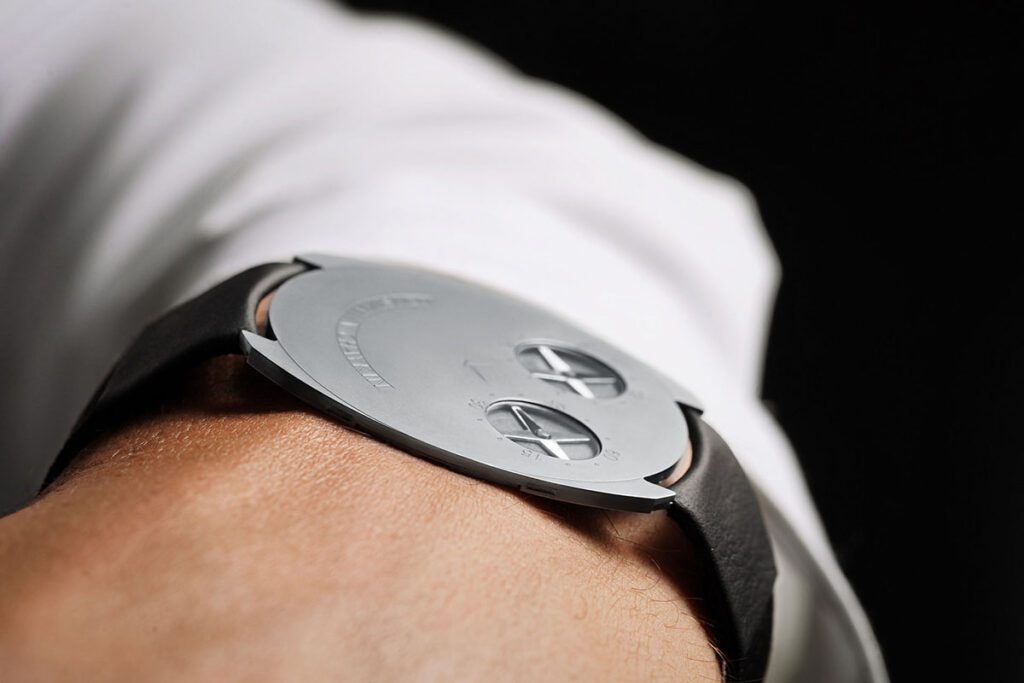
The race to break thinness records is a niche but prestigious challenge, undertaken by only a handful of watchmakers striving to outdo one another in crafting the world’s thinnest timepiece. The year 2024 was marked by three standout ultra-thin models—topping them all, quite fittingly, was the ThinKing, a creation whose name says it all. Conceived by Russian watchmaker Konstantin Chaykin, it signaled his entry into the exclusive circle of brands—countable on one hand—that dominate the world of extreme slimness. Vacheron Constantin, Piaget, Bulgari, and Richard Mille now welcome a new “king” into their ranks.
Let’s take a closer look at the three thinnest watches of the year…
KONSTANTIN CHAYKIN ThinKing
The Thinnest Manually Wound Watch
The king of thin watches stole the spotlight from Bulgari. To bring this visionary concept to life, Chaykin had to push the limits of imagination and engineering. It took him more than six months of deep R&D and technical experimentation.
At the Geneva Watch Days exhibition in August 2024, he unveiled a fully functional prototype: the ThinKing Prototype 2.

Thickness: Just 1.65 mm, narrowly beating the Bulgari Octo Finissimo Ultra COSC (1.7 mm), which had held the world record since April 2024. Key difference: The Bulgari is automatic, while the ThinKing features a manual-winding movement.
Weight: Only 13.3 grams (excluding strap), placing it among the lightest watches ever made.
The ThinKing draws inspiration from a 19th-century Bagnolet-style pocket watch movement with a cylindrical escapement, crafted by Geneva watchmaker Auguste Golay Leresche.

Chaykin has filed three patents related to the ThinKing:
An ultra-thin mainspring barrel
A double balance wheel system
A specially engineered ultra-thin strap made of black alligator leather, featuring elastic inserts and flexible titanium lugs
The movement, the ultra-thin caliber K.23-0, is fully integrated into a 40 mm stainless steel case. It consists of 204 components, contains 51 jewels, and is wound using a special key.

Like other pieces in Chaykin’s Wristmon series (short for “Wrist Monster”), the ThinKing has an anthropomorphic dial: the hour (left) and minute (right) indicators appear as eyes, while the designer’s name forms a smiling mouth. Chaykin wanted to inject a sense of emotion and personality into what would otherwise be a purely technical watch.
BULGARI Octo Finissimo Ultra COSC
The Thinnest Automatic
Unveiled at Watches & Wonders 2024, the Octo Finissimo Ultra COSC held the title of the world’s thinnest watch until August that year—when it was dethroned by Konstantin Chaykin’s ThinKing. But as its name suggests, this Bulgari creation also carries the coveted COSC chronometer certification from Switzerland’s official chronometry authority.

Back in 2023, I had a conversation with Fabrizio Buonamassa Stigliani, Bulgari’s Creative Director, who confidently told me that the 1.8 mm-thick Octo Finissimo Ultra would be the house’s final word in ultra-thin record-breaking. Of course, at the time, the Richard Mille RM UP-01 Ferrari—measuring just 1.75 mm—had yet to launch. So, in 2024, Bulgari returned to the race, pushing boundaries once more by reducing the thickness to just 1.7 mm.
Thinner than a coin yet impressively robust and elegant on the wrist, this timepiece is the result of a collaboration between Bulgari and Concepto, an independent Swiss manufacturer based in La Chaux-de-Fonds known for high-end mechanical movements.

To shave off even a tenth of a millimeter from the previous record, Bulgari had to re-engineer both the 40 mm case and the sapphire crystal. The caseback doubles as the mainplate of the hand-wound movement, which is composed of 170 components. To meet COSC certification standards, the mainplate was made from a particularly dense and hard tungsten carbide.

The central case body, bezel, and lugs are crafted from sandblasted titanium.
The watch’s full surface is cleverly utilized: the hour and minute subdials on the right are made from sandblasted brass coated in grey PVD, while the large barrel, which provides a 50-hour power reserve, and the escapement system are positioned on the left. At 6 o’clock, the small seconds are displayed on the fourth wheel.

The Octo Finissimo Ultra COSC also redefines the winding and setting experience. In addition to manual winding, the watch can be placed into a special presentation box equipped with a digital interface. Simply program your desired time, press a button, and within seconds the watch is precisely wound and set.
Even the titanium bracelet is a mechanical marvel: just 1.5 mm thick, it includes a deployant clasp. Only 20 pieces of the Octo Finissimo Ultra COSC will be made, each priced at €600,000.
PIAGET Altiplano Ultimate Concept Tourbillon
The Thinnest Tourbillon
Debuting at Watches & Wonders 2024, the Altiplano Ultimate Concept Tourbillon marks another ultra-thin milestone from Piaget, a brand long recognized for its mastery in ultra-slim horology. Though Piaget lost the world record for the thinnest watch to Bulgari in 2022, it has now claimed victory in a different category—by integrating a flying tourbillon into a watch that’s just 2 mm thick.
To achieve this, Piaget redesigned 90% of the components from its original Altiplano Ultimate Concept and even developed new tools to make the feat possible. It took three years of secret development at the Piaget Manufacture in La Côte-aux-Fées.
The watch features a 41.5 mm case made from a cobalt alloy with blue PVD coating. Cobalt was chosen for its superior hardness and rigidity—essential qualities for such a slim profile.

The Altiplano’s flying tourbillon moves along a circular path thanks to a surrounding bridge—an entirely new configuration in horology. Thanks to Piaget’s 2013 invention of the caliber 900P, the case and movement are unified into a single structure. To save every possible micron of space, the caseback also serves as the movement’s mainplate.
Looking at the dial, the hour and minute subdial is placed slightly to the right of 12 o’clock, while the tourbillon sits at 10 o’clock, with small seconds engraved directly on its outer ring.

Fitting a tourbillon into a 2 mm profile was a staggering achievement. The space was already so limited that Piaget’s engineers had to go through 70 iterations of the tourbillon cage, 15 versions of the escapement, and 30 different case designs before finalizing the construction.
Price: €735,000