What happens when you remove the very hand that has, until now, confirmed accuracy? Omega makes a decisive move with the Constellation Observatory, its first Master Chronometer timepieces without a seconds hand.
For years, the concept of accuracy in watchmaking has been inseparably linked to what we see. A smoothly sweeping seconds hand, a visual confirmation that everything is functioning as it should. The certification process—whether at chronometer level or within the more demanding Master Chronometer framework established by METAS—relied precisely on this: observation. With the new Constellation Observatory collection, Omega steps away from this logic. And it does so through a technology that, the less “visible” it is, the more decisive it proves to be. And the most striking part? We are talking about certified chronometers that do not have a seconds hand. Unbelievable?
How is that even possible?
Thanks to the Laboratoire de Précision, established by Omega in 2023 as an independent certification body, which has developed an acoustic testing method that changes everything. Instead of relying on the visual recording of the seconds hand position, the new process essentially “listens” to the movement. It captures the acoustic signature of every oscillation and analyses it in real time.
At the heart of this process lies Dual Metric technology, operating as a fully autonomous testing unit. Over a period of 25 days, it continuously collects data—not only on the operating frequency, but also on the conditions under which it evolves. Temperature, position, magnetic fields and atmospheric pressure are all recorded simultaneously, creating a complete behavioural profile of the movement.
The difference compared to traditional methods is fundamental. Where there was once a single snapshot per day, there is now a continuous stream of information. And this stream allows something that was previously impossible: the precise mapping of when and why a deviation occurs.
The result of this development is perhaps the most compelling aspect of the new collection. For the first time in the history of watchmaking, a two-hand watch—displaying only hours and minutes—can be certified as a Master Chronometer. Thanks to Omega, the seconds hand, which for decades was considered essential for verifying accuracy, is now rendered unnecessary. And this is not merely a technical detail, but a major step forward of historical significance.
Constellation: a legacy that continues
This technological breakthrough becomes even more meaningful when viewed within the historical context of the Constellation collection. Since 1952, this line has represented the most consistent expression of Omega’s commitment to certified accuracy. Every mechanical Constellation was, by definition, a chronometer. And later, with the introduction of the renowned co-axial escapement and anti-magnetic movements, the brand reinforced this identity even further.
Now, the new Constellation Observatory collection becomes another link in this evolutionary path towards ultimate precision. This time, however, it shifts the concept of accuracy from the level of indication to the level of understanding.
The designof the newcollection
From a design perspective, the Constellation Observatory collection adopts a restrained approach. Its fundamental inspiration traces back to the 1948 Centenary, which laid the foundations for the Constellation line. The dodecagonal pie-pan dial, the signature star above 6 o’clock, the Dauphine hands and the Observatory medallion on the caseback all continue the visual language of historical Constellation models.
The faceted kite-shaped hour markers and the distinctive “dog-leg” lugs reintroduce details closely associated with the 1950s and 1960s, while the guilloché finishing draws inspiration from the Grand Luxe models of the same era. In addition, the nine-row “brick” pattern on the 18K Moonshine™ gold bracelet references the vintage bracelets of early Constellation watches.
It is no coincidence that Omega has chosen this particular aesthetic direction for its new timepieces. Since the innovation lies primarily within, the external design serves as a bridge to the past.
The new movements
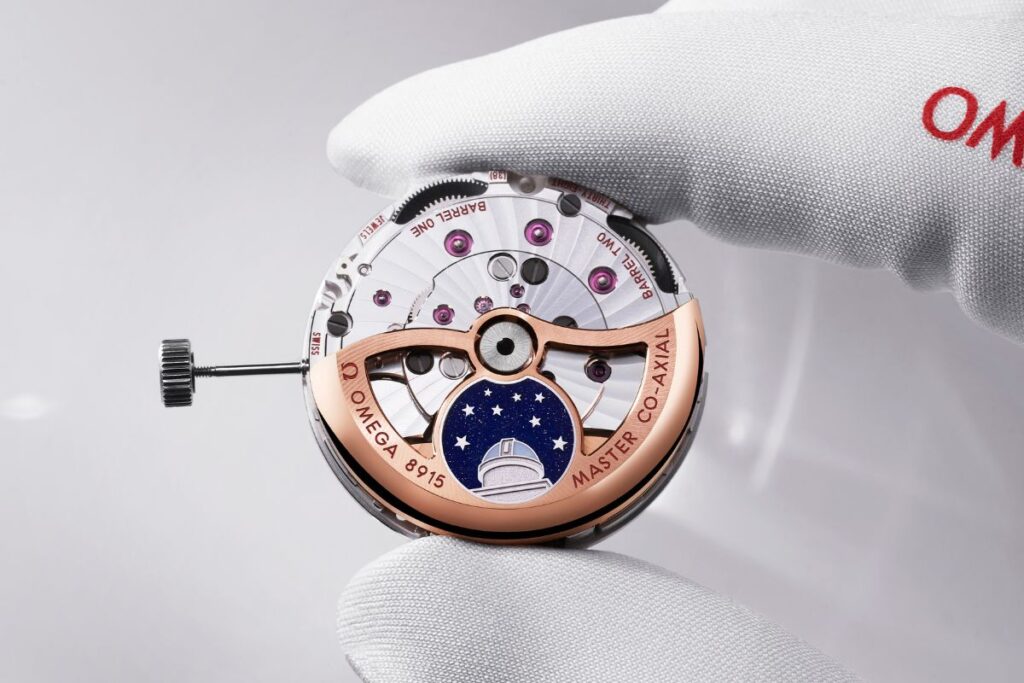
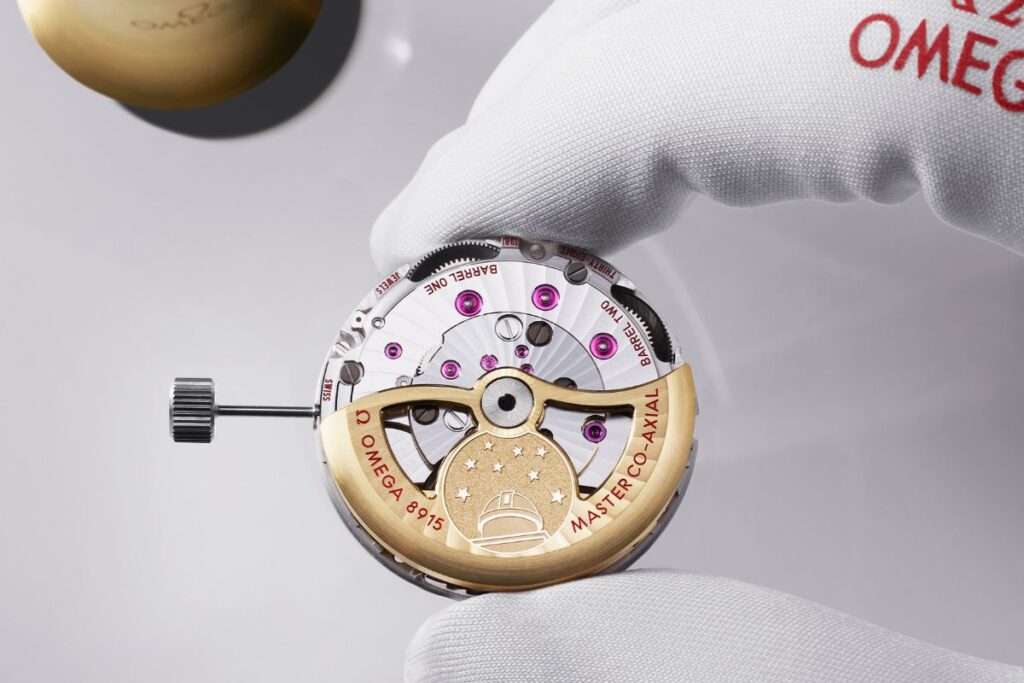
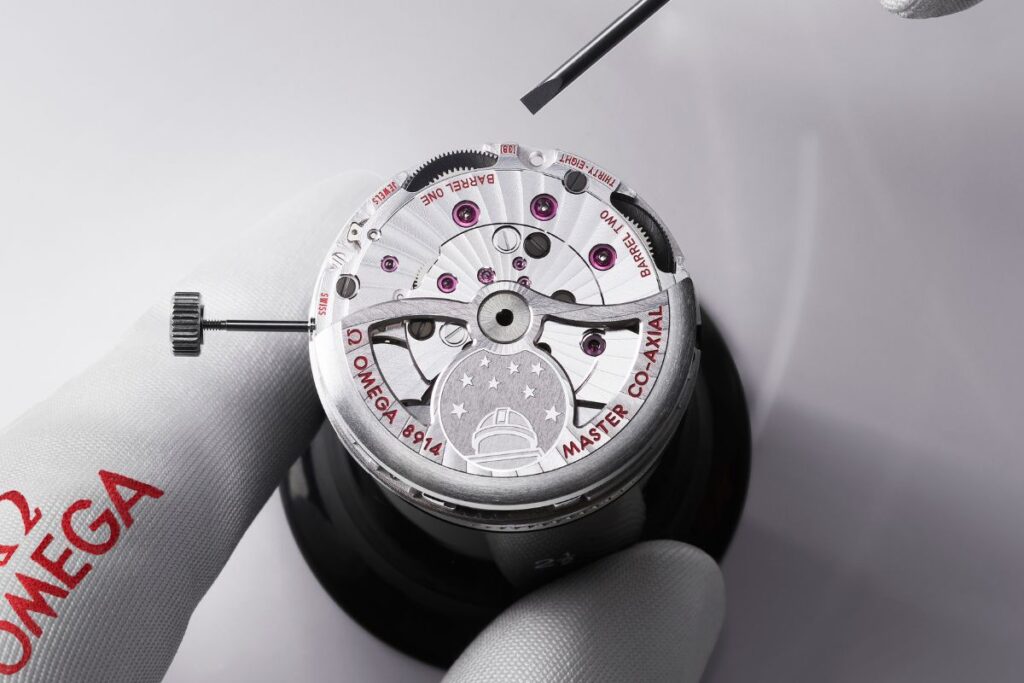
Inside, however, the picture is entirely different. The two new movements, Calibre 8915 and Calibre 8914, have been developed with a focus on both performance and contemporary aesthetics. The rotor base is skeletonised, with carefully executed bevelled edges and a rounded outer zone, while the Observatory medallion is integrated as a central decorative element. Depending on the model, three movement categories are offered:
In the Calibre 8915 Grand Luxe, the Sedna™ gold rotor and the white gold medallion with aventurine enamel create a composition that resembles fine micro-sculpture.
In the Calibre 8915 Luxe, the use of Moonshine™ gold for both the rotor and the balance bridge marks a first for the brand, adding an additional layer of refinement without disrupting the overall design coherence.
The Calibre 8914Standard, used in the O-MEGASTEEL versions, retains the same architecture with a rhodium-plated finish, offering a more contemporary and “everyday” interpretation.
The full gold model from the OMEGA Constellation Observatory collection, and on the right, the platinum version.
9 Variations on a theme
The new Constellation Observatory collection consists of nine models in total: four in gold, four in steel and one in platinum. Their primary distinction, therefore, lies in the material from which they are crafted. This variety of materials enhances the overall complexity. Sedna™ gold, Moonshine™ gold, Canopus Gold™ and Platinum-Gold appear together for the first time within a single collection, presenting a complete picture of Omega’s capabilities in precious alloys.
All four OMEGA Constellation Observatory models in O-MEGASTEEL.
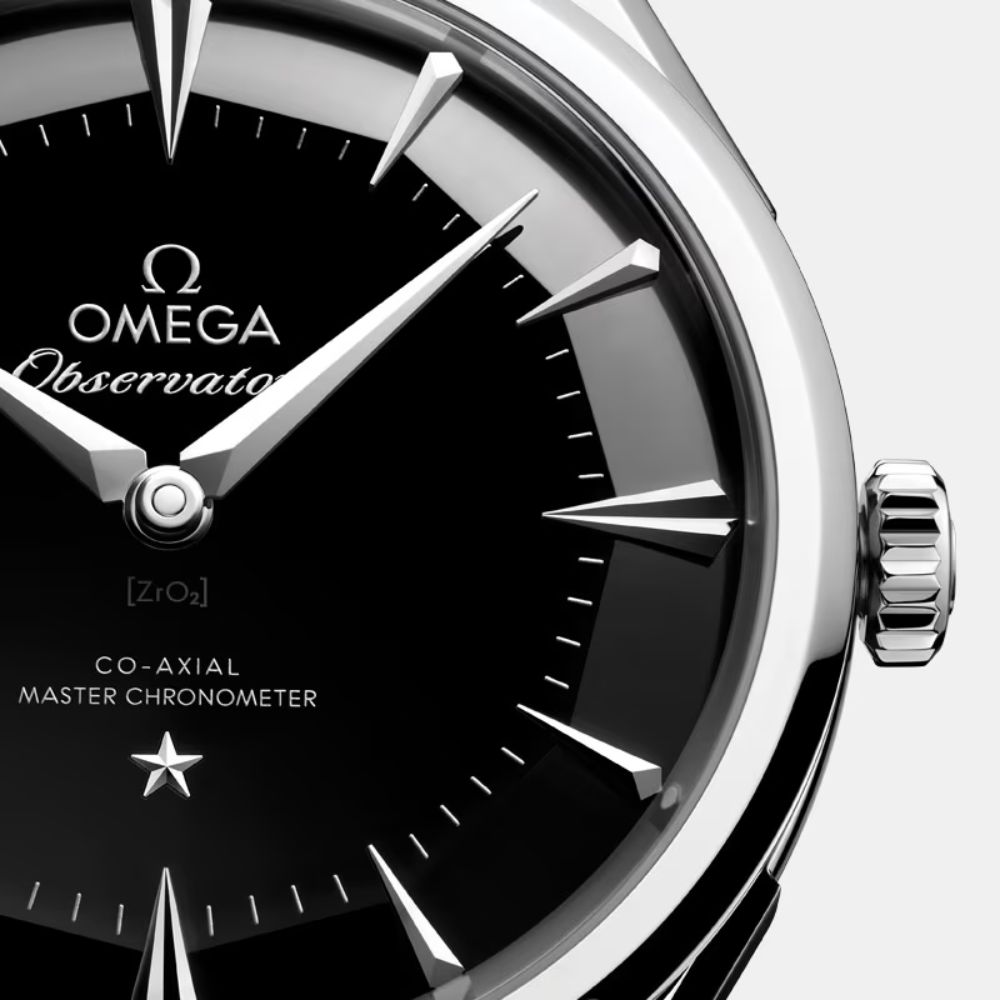
At the same time, the O-MEGASTEEL versions introduce a different aesthetic direction. All feature pie-pan dials, three of them with engraved grooves around the periphery that emphasise the play of light, while a fourth stands out with a glossy black ceramic dial.
Detail of the OMEGA Constellation Observatory in O-MEGASTEEL with a black ceramic dial.
A different approach to innovation
Looking at the collection as a whole, it becomes clear that the Constellation Observatory is not simply a new series of models. It can be seen as a statement of intent, an indication that Omega aims to push even further into the domain of precision. At a time when watchmaking often seeks innovation through the addition of increasingly complex functions, Omega takes a different path: it removes one hand and, at the same time, introduces a new level of accuracy. Perhaps that is ultimately the most meaningful aspect of this collection. Not that it is more technologically advanced, but that it compels us to see—or rather, to listen to—accuracy in an entirely different way.
Prices start at €11,000 for the stainless-steel models and reach €59,600 for the full Moonshine™ gold version.
The new HydroConquest collection by Longines returns with cleaner lines, two well-balanced case sizes and meaningful upgrades. A diver that remains true to its
Bvlgari, in collaboration with National Geographic CreativeWorks, has created a documentary titled A Celebration of Color — a dreamlike journey into the heart of
What happens when you remove the very hand that has, until now, confirmed accuracy? Omega makes a decisive move with the Constellation Observatory, its
Now this was a surprise. Independent watchmaker Krayon, known for its uniquely conceived complications, invites us to return to our childhood and… play PAC-MAN.
Exactly half a century after Concorde’s first commercial flight, the Navitimer B01 Chronograph 43 Tribute to Concorde brings together two legends of aviation, capturing
We use cookies to improve your experience on our site. By using our site, you consent to cookies.
This website uses cookies
Websites store cookies to enhance functionality and personalise your experience. You can manage your preferences, but blocking some cookies may impact site performance and services.
Essential cookies enable basic functions and are necessary for the proper function of the website.
Name
Description
Duration
Cookie Preferences
This cookie is used to store the user's cookie consent preferences.
30 days
These cookies are needed for adding comments on this website.
Name
Description
Duration
comment_author
Used to track the user across multiple sessions.
Session
comment_author_email
Used to track the user across multiple sessions.
Session
comment_author_url
Used to track the user across multiple sessions.
Session
These cookies are used for managing login functionality on this website.
Name
Description
Duration
wordpress_logged_in
Used to store logged-in users.
Persistent
wordpress_sec
Used to track the user across multiple sessions.
15 days
wordpress_test_cookie
Used to determine if cookies are enabled.
Session
Statistics cookies collect information anonymously. This information helps us understand how visitors use our website.
Marketing cookies are used to follow visitors to websites. The intention is to show ads that are relevant and engaging to the individual user.
You can find more information in our Cookie Policy and .
Subscribe
About Us
Contact Us
Join our newsletter and get the latest news and articles sent straight to your inbox weekly.